

Under The Radar
About
We speak with businesses, industry leaders, venture capitalists and startups on their assessment of the business environment they're in, and what the future holds for them.
DEC 16, 2024
16/12/24 - Under the Radar: How is CDG ENGIE navigating complexities in its quest to expand regionally?
Supporting the electric vehicle charging infrastructure in Singapore and beyond – that’s the agenda of our conversation as we speak to our guest CDG ENGIE.
Founded in 2021, CDG Engie, also known as ComfortDelGro ENGIE, is a joint venture between ComfortDelGro Engineering and ENGIE South East Asia, the regional subsidiary of French multinational utility company ENGIE Group.
The JV focuses on providing end to end solutions for customers in their transition towards sustainable and greener energy. So far, the company prides itself as a leading EV charging operator in Singapore with a network of over 2,700 charge points across Singapore, Malaysia and Thailand.
But why are we speaking to CDG ENGIE you might ask? Well, the firm is on the charm offensive to expand its network right now, having been awarded the first public EV charger deployment contract to deploy mainly fast EV charging points across 20 sites at primarily HDB commercial complexes in June 2024.
The firm also recently celebrated its third anniversary in October and operationalised its 1000th charge point located in Serangoon on the 16th November.
Beyond Singapore, CDG ENGIE is also said to have the largest cross-border roaming network in the region through strategic partnerships with industry players ChargeEV and Gentari.
To this end, a new mobile app has also been launched this year to allow users to plan ahead for road trips and calculate the necessary charging stops based on the specifications of their vehicles.
But what should we know about CDG ENGIE’s expansion plans? How does the firm navigate complexities in regional expansion given the different stages of electric vehicle adoption and infrastructure development?
On Under the Radar, Money Matters’ finance presenter Chua Tian Tian posed these questions to Freddie Chew, General Manager, ComfortDelGro ENGIE.
|


|


|
|
24:18
|


DEC 12, 2024
12/12/24 - Under the Radar: Why is Taiwan-based Cathay United Bank expanding in Singapore?
It’s back to the banking industry today as we speak to a Taiwanese bank set up nearly half a century ago.
Established back in 1975, our guest for today is Cathay United Bank, a subsidiary of Cathay Financial Holdings.
Cathay Financial Holdings, for context, is a financial conglomerate with businesses spanning insurance, asset management and brokerage, with its Chairman Tsai Hong-tu having a net worth of US$5.3 billion based on the Bloomberg Billionaires Index.
Back to Cathay United Bank, the bank boasts 165 branches throughout Taiwan, placing it as one of the leading players in the island when it comes down to credit cards in force as well as transaction volumes.
Outside of its home market, Cathay United Bank has a presence in 67 overseas locations across mainland China, Vietnam, Cambodia, Hong Kong, Singapore, the Philippines, Malaysia, Laos, Myanmar, Thailand and Indonesia.
But what are we speaking to Cathay United Bank you might ask? Well, the bank is an interesting one to look at because it is now expanding its headcount in Singapore, as their clients double down on their operations and presence in the Southeast Asian region. But what should we know about its expansion plans here?
Meanwhile, Cathay United Bank had in May 2024 saw net income increasing 13 per cent on the year to over US$950 million in 2023. But how is its Singapore business faring thus far? Also – what will the focus areas be for the firm’s operations here in Singapore looking ahead?
On Under the Radar, Money Matter’s finance presenter Chua Tian Tian posed these questions to Winfield Wong, CEO, Cathay United Bank (Singapore).
|
|
|
|
|
20:01
|
DEC 10, 2024
10/12/24 - Under the Radar: How does Cloudflare navigate increased competition and lower enterprise spending and what are the opportunities ahead?
Ever clicked into an online website only to see a pop-up that writes “verify you are human”?
If you’ve scrutinised the pop-up, chances are, you might find a logo at the side that says “Cloudflare”.
And if you have found the logo – then bingo – you’ve already been introduced to our guest for today.
Founded in 2009, Cloudflare is a leading connectivity cloud company listed on the New York Stock Exchange. While it offers security solutions like popups to verify human users, its business spans way beyond that.
The firm said it empowers users to make their employees, applications and networks faster and more secure everywhere while reducing complexity and cost. That’s through its suite of cloud-native products and developer tools for companies to develop and accelerate their businesses.
Cloudflare had in November 2024 forecasted fourth quarter revenue of between US$451 million and US$452 million, lower than the analysts’ average estimate of US$455.7 million based on data compiled by LSEG.
The expectations came amid intensifying competition among cloud and cybersecurity players and as enterprises dial back on expenditures as they look to an uncertain global economy.
But how does the firm assess its current operating environment and what does the road ahead look like for it?
On Under the Radar, Money Matters’ finance presenter Chua Tian Tian posed these questions to Ben Munroe, Vice-President of Marketing, Asia Pacific at Cloudflare.
|
|
|
|
|
35:24
|
DEC 6, 2024
06/12/24 - Under the Radar: What is Web 3.0 mobility and where does TADA and ONiON Mobility fit in MVL’s bigger business?
You might have heard of the global ride hailing service called TADA, which was launched back in 2018, but how much do you know about its parent company MVL?
Well, this is an interesting one, because its parent MVL is actually an incentive-based blockchain mobility ecosystem, more so than a transport app maker.
Its consumer facing businesses include the ride hailing service TADA, as well as ONiON Mobility, an electric vehicle manufacturing and battery charging infrastructure brand best known for its electric tuk-tuks in Cambodia
Behind the action, MVL also has other business verticals including a decentralised physical mobility infrastructure network that collects mobility data as well as a crypto wallet called Clutch.
The mechanics of the business may be complicated, but MVL said it can be better understood as a player providing Web 3.0 mobility. But what is Web 3.0 mobility exactly? And how does MVL see Tada and ONiON mobility’s roles in its blockchain ecosystem?
Aside from the mechanics, MVL is also a company to zoom in on because it is seeing some developments of late relating to Tada and ONiON mobility specifically.
For one thing, Tada had said in August 2024 that it will expand into Hong Kong as authorities there plan to regulate private ride-hailing services. But what were the reasons behind entering Hong Kong, and what are the key drivers of growth for the business?
Where will it expand into next, say Vietnam, after fellow industry player Gojek exited the country after six years?
And on ONiON mobility had in May 2022 launched a US$20 million electric motorcycle and three-wheeler assembly plant in Cambodia. But what’s next for the firm on this front?
On Under the Radar, Money Matters’ finance presenter Chua Tian Tian posed these questions to Sean Kim, Chief Executive Officer at TADA Mobility and Chief Operating Officer at MVL.
|
|
|
|
|
25:46
|
DEC 4, 2024
04/12/24 - Under the Radar: Why is Jebsen & Jessen expanding through M&As in Southeast Asia? Its Chairman spills the beans.
On our show today is a global family enterprise that could be dated back to a trading partnership formed in Hong Kong back in 1895.
That’s right. Now headquartered in Singapore, our guest Jebsen and Jessen Group has evolved into a diversified industrial conglomerate specialising in engineering, mining and distribution activities through Southeast Asia and beyond.
These days, Jebsen & Jessen’s business can be split into seven units, namely: Cable Technology, Industrial Garnet, Ingredients, Life Sciences, Mobility, Industry & Beverage, as well as Packaging and Technology.
The company has a turnover of S$1 billion. Its 3,000-man strong workforce spans across its operating entities in 12 countries. That includes 13 manufacturing facilities.
But why are we talking to Jebsen & Jessen you might ask? Well, we are speaking to Jebsen & Jessen because the firm had said in May 2023 that it was and still is actively in search of acquisition targets particularly in the specialty chemicals and rigid packaging businesses.
The firm said then that it is on the lookout for targets in Southeast Asian markets such as Vietnam, the Philippines, Thailand and Indonesia. But what was the rationale behind expanding inorganically? What are the opportunities here in Southeast Asia?
And more importantly, how does Jebsen & Jessen intend to create synergies given the diversified nature of a conglomerate? How will it ensure efficiency and reduce overlaps in its business operations as it embarks on more mergers and acquisitions for growth?
On Under the Radar, Money Matters’ finance presenter Chua Tian Tian posed these questions to Heinrich Jessen, Chairman of Jebsen & Jessen Group.
|
|
|
|
|
34:43
|
DEC 2, 2024
02/12/24 - Under the Radar: OpenAI’s MD for international markets Oliver Jay on its Singapore operations, potential of generative AI and future research direction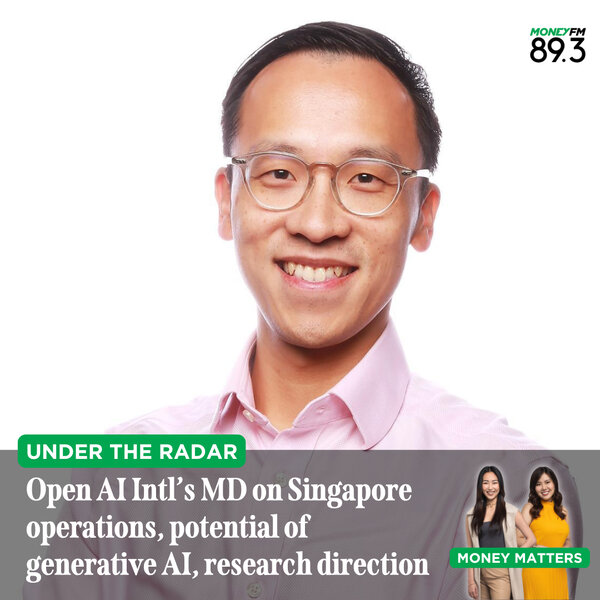
Building safe and beneficial artificial general intelligence that could benefit all of humanity and enrich our lives. That’s what we are going to talk about today.
Founded in 2015, our guest for today is AI research and deployment company OpenAI.
The firm is famously known for its flagship AI model or chatbot ChatGPT, which reacts to questions in a conversational way. The chatbot could even admit its mistakes when confronted, and refine its answers for greater accuracy.
Aside from that, OpenAI also boasts other products including Dall-E, which is an AI system that can generate realistic images using text prompts.
OpenAI is an interesting company to talk about because of the limitless potential of generative AI solutions. Most recently, the firm had in October 2024 introduced canvas, an interface that allows ChatGPT to collaborate with human users on a project.
It also launched ChatGPT Search later that month. The solution is said to search the web in a much better way than before. It’ll include the links to sources such as news articles for easy referencing.
But how much money can generative AI bring to the table in terms of efficiency? How exactly do we draw the boundaries to the potential of generative AI? And how far does this compare against current market expectations looking at the AI-led boom in tech stocks for much of this year?
Meanwhile, OpenAI had in October 2024 announced plans to open an office in Singapore, its second in Asia Pacific after Tokyo. It also held its first developer day in the country. But what are the opportunities in Singapore, and how does the firm intend to expand internationally going forward?
Also – with media reports circulating that the firm is in talks to transform its non-profit structure into a for-profit structure, what implications would this have on the firm’s direction of research?
On Under the Radar, Money Matters’ finance presenter Chua Tian Tian posed these questions to Oliver Jay, Managing Director, International at OpenAI.
|
|
|
|
|
39:53
|
NOV 28, 2024
28/11/24 - Under the Radar: Ninja Van’s CEO on moving into B2B delivery and cold chain businesses, challenges in operating within the logistics industry now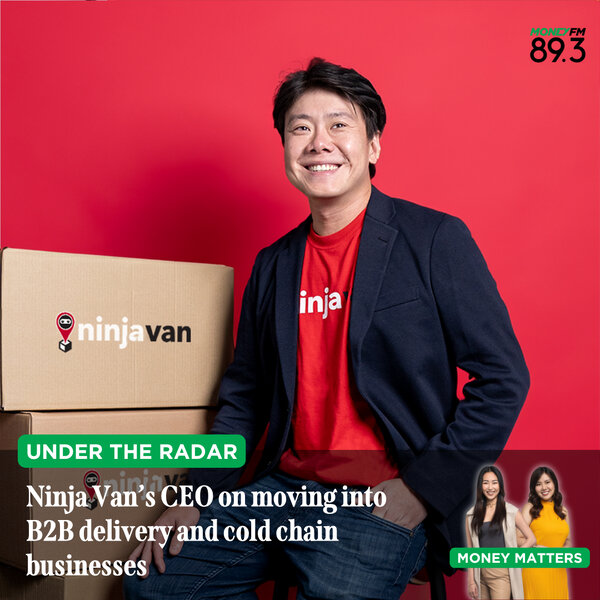
Today we’re going to talk about a logistics company that started out of a second hand van a decade ago.
Founded in 2014 by a group of three friends, our guest is e-commerce express logistics company Ninja Van Group. Fast forward to the present, the firm is now a technology enabled logistics organisation backed by marquee investors including GeoPost, Alibaba, and B Capital Group.
Just to give you a sense of the firm’s scale, Ninja Van said it has a 100% coverage across Southeast Asia, with established operations and networks in six key markets.
It offers logistics and supply chain products and services for nearly two million shippers, with some two million parcels delivered by its team of over 66,000 people daily.
Ninja Van is a company that we want to look at because the firm had in April 2024 launched a cold chain offering called Ninja Cold, as well as a business-to-business offering Ninja B2B, as part of efforts to diversify beyond e-commerce and search for higher margin businesses.
The move come as the firm’s latest financial filings for the financial year ended June 2023 revealed a loss of S$326.8 million in 2023 versus a loss of S$250.2 million in 2022.
So how does the firm assess its latest financial numbers? What does this say about the opportunities and challenges in operating and expanding within the logistics space?
And how successful has Ninja Cold and Ninja B2B been over half a year after they were launched?
On Under the Radar, Money Matters’ finance presenter Chua Tian Tian posed these questions to Lai Chang Wen, CEO, Ninja Van.
|
|
|
|
|
30:49
|
NOV 22, 2024
22/11/24 - Under the Radar: In the business of love – Match Group Asia’s CEO on what success means for the firm and helping people tie the knot in Japan
It is all about the business of love today as we speak to a leading provider of digital technologies designed to help people make meaningful connections.
Founded 25 years ago, our guest today is Match group, which pioneered the concept of online dating and continues to foster innovation in the dating industry daily.
The firm boasts a portfolio of brands and is more commonly known as the company behind Tinder, Match and Pairs, providing matching services in over 40 languages to users all over the world.
Today, Match Group has a footprint in 20 offices worldwide, hiring some 2,000 employees. Here in Asia, it is headquartered in Singapore, with its regional team spread across markets including Japan, South Korea, Australia, India, Vietnam and Thailand.
The company recently reported its third quarter financial performance, where its operating income stood at US$211 million, down 14 per cent on the year impacted by impairments of tangibles and other charges relating to its exit from Hakuna and other live streaming services. But what were the reasons behind the exit, and how is its Asia business faring on the whole?
Speaking of Match Group’s Asia business, the firm is largely zoomed in on the Japanese market through its dating and marriage app called “Pairs”.
With a total of over 20 million registered users, Pairs is said to have facilitated every one in 10 marriages in Japan. But what are the key learnings from Pair’s operations in Japan, and how far can the operating model in Japan be replicated in other Asian markets with lower marriage rates?
On Under the Radar, Money Matters’ finance presenter Chua Tian Tian posed these questions to Malgosia Green, CEO of Match Group Asia.
|
|
|
|
|
25:44
|
NOV 21, 2024
21/11/24 - Under the Radar: NCS NEXT on transformation and how generative AI would reshape the focus of its earlier strategic reset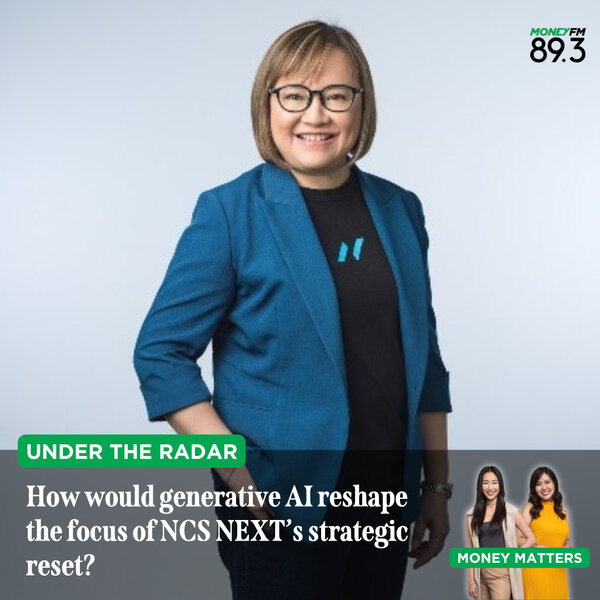
Opening new frontiers in information technology and pioneering the future of innovation. That is what we are going to talk about today with our guest from a leading technology services firm in Asia Pacific.
Founded in 1981, NCS is a subsidiary of Singtel Group that provides what it calls differentiated and end-to-end services to clients with its capabilities in core areas such as application, infrastructure, engineering and cybersecurity.
The firm partners with governments and enterprises across industries such as hospitality, manufacturing, logistics and even healthcare to advance communities through technology.
Such technologies include the Breeze app, which utilises computer vision and artificial intelligence to help users get around local neighbourhoods such as Tiong Bahru more easily.
Why are we speaking to NCS you might ask? Well, we’re speaking to NCS because the firm is currently doubling down on innovation in emerging areas such as digital, data, cloud and platform through its digital services arm NEXT.
That’s after the company had in July 2021 announced a major business transformation to reposition it for growth in the 5G era.
The strategic reset then focused on growing digital services, scaling its government and telco business segment and capturing new growth opportunities in the enterprise sector across key regional markets of Singapore, Australia and Greater China.
But what has been done thus far and how important is NCS NEXT to the firm alongside its other strategic business groups? And what will the rapid adoption of generative AI mean for the firm as it looks to the second half of the decade?
On Under the Radar, Money Matters’ finance presenter Chua Tian Tian posed these questions to Wynthia Goh, Senior Partner, NCS NEXT.
|
|
|
|
|
26:46
|
NOV 14, 2024
14/11/24 - [SFF 2024 Special] Panel on Bridging the Financial Gap with ANEXT Bank and Triple-A
This year’s Singapore Fintech Festival surrounds six major themes that will frame 2025.
One of the themes among industry leaders, in particular, is the need to bridge the financial gap and ensure equitable access and usage of financial services and products to the underserved.
On this note, did you know that 1.4 billion people globally still lack access to bank accounts? Yes, and that is according to an article published on the World Economic Forum in just September this year.
So what can we then do to level the playing field for the underbanked and underserved – both individuals and budding entrepreneurs who are starting out?
Well, the numbers appear to point to fintech as the answer, given increased internet adoption and digitalisation.
In this panel discussion on "Bridging the Financial Gap", we talked about the challenges individuals as well as Micro, Small and Medium-sized Enterprises faced in accessing traditional financial services and how the use of digital banking and digital tokens can level the playing field for the underserved.
We also looked at the metrics used to determine progress towards equitable financial outcomes and identify areas for further intervention, and the need to ensure that digital technologies continue to narrow and not widen the wealth gap.
As part of MONEY FM’s on the ground coverage of Singapore Fintech Festival 2024, Money Matters’ Finance Presenter Chua Tian Tian spoke with Kai Qiu, Deputy CEO and CTO, ANEXT Bank and Eric Barbier, CEO, Triple-A for more.
|
|
|
|
|
22:57
|


