

Under The Radar
About
We speak with businesses, industry leaders, venture capitalists and startups on their assessment of the business environment they're in, and what the future holds for them.
MAR 20, 2024
20/03/24 - Under the Radar: Chipsafer’s quest to trace livestock and to prevent disease and Cattle theft
Improving the safety and security of livestock herds by ensuring traceability across the animal’s lifecycle. That is what we’re talking about.
Founded in 2013, our guest is Chipsafer, an internet-of-things company that offers real-time Cattle tracking solutions that captures useful data such as the current and historic health, the behaviour and the transaction information of livestock.
By understanding where animals are, how they are feeding, and how they are behaving, Chipsafer says farmers can isolate issues and prevent catastrophic loss of livestock due to disease outbreaks.
It could also better increase the efficiency and sustainability of operations. Aside from that, the firm also aims to tackle the issue of cattle theft, an issue prevalent in markets such as Kenya given that many farmers rear their animals in open-ranges that are susceptible to rustling.
With Markets and Markets estimating the agriculture internet to grow from US$11.4 billion in 2021 to US$18.1 billion by 2026, at a CAGR of 9.6 per cent during the forecast period (of 2021 to 2026), what opportunities does Chipsafer see in the space?
And are they mostly located within agricultural-based economies and can Chipsafer’s solutions be adapted for modern farmers within Asia?
On Under the Radar, The Evening Runway’s finance presenter Chua Tian Tian posed these questions to Victoria Alonsoperez, Founder & CEO, Chipsafer.
|


|


|
|
25:52
|


MAR 18, 2024
18/03/24 - Under the Radar: Applied Materials on navigating a challenging business operating environment; innovation, new machine and role of Southeast Asia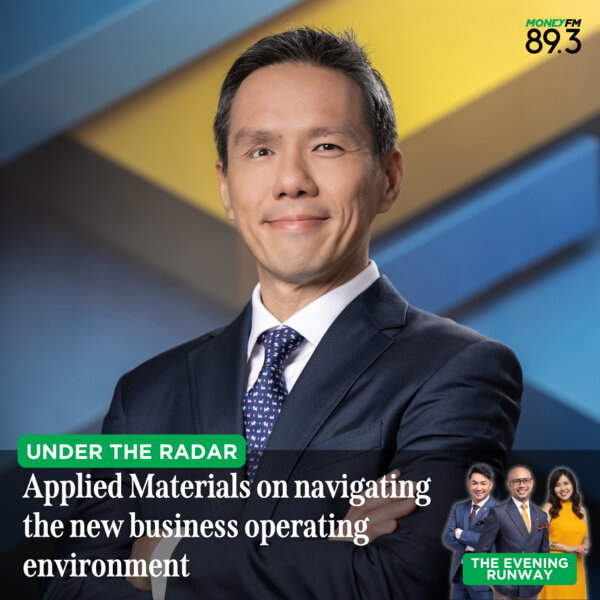
We’ve talked in depth about semiconductor makers on the show, and today we want to go one step further to look at the largest manufacturers of semiconductor equipment in the US.
With an annual revenue of US$26.52 billion, our guest Applied Materials is a leader in materials engineering solutions used to produce virtually every new chip and advanced display in the world.
The chipmaking tool giant counts tech titans Intel and Samsung among its customers. It had in February reported first quarter revenue of US$6.71 billion, beating estimates, with China’s sales of US$3 billion accounting for 45 per cent of total revenue, up from 17 per cent seen a year ago.
But how does the firm assess the wider business environment given increasing US-China tensions and US curbs to export chipmaking equipment to China, and the increased adoption of innovative solutions like chiplets?
Meanwhile, Applied Materials had in 2022 announced that it is building a S$600 million plant here to expand its manufacturing and research operations with plans to further expand in the city state before the end of the decade. But what was the rationale behind the move?
On Under the Radar, The Evening Runway’s finance presenter Chua Tian Tian posed these questions to Brian Tan, Regional President, Southeast Asia and Vice President, Applied Global Services, Applied Materials.
|
|
|
|
|
20:29
|
MAR 14, 2024
14/03/24 - Under the Radar: A digital family office for all - Google CEO Sundar Pichai-backed Arta Finance on its quest to become the next tech unicorn
Today we’re going to talk about a two-year old startup invested by Google’s CEO Sundar Pichai.
Founded by a team of former Google executives, Arta Finance transforms the way people grow, protect and enjoy wealth by helping people gain the financial superpowers that were previously the domain of ultra-high net worth individuals.
It uses artificial intelligence and machine learning to enable intelligent investing in public market equities, as well as other alternative asset classes such as private equity, venture capital and real estate.
The platform aims to serve professionals who have a higher net worth but are not yet able to access private bank services or to have their own family offices. Think of Arta Finance like a personal digital family office with lower barriers to entry.
Since coming out of stealth mode in late 2022, the firm has raised over US$90 million from institutional investors such as Peak XV Partners (also formerly known as Sequoia Capital India), Ribbit Capital, Coatue and over 140 luminaries in the tech and finance space – including, again, Google’s CEO Sundar Pichai and former Google CEO Eric Schmidt. But what is in it for this group of players to come onboard?
Meanwhile, the firm started offering its services in the US through an invite-only model in early 2023 and has since managed over US$100 million on members’ behalf. It plans to open its services in Singapore sometime this year.
But why did the firm choose the US and Singapore as markets to enter into as a start? What can we expect from its Singapore launch?
How far will the firm’s plans to expand aggressively take off from here? And how far away is it from becoming the next fintech unicorn?
On Under the Radar, The Evening Runway’s finance presenter Chua Tian Tian posed these questions to Caesar Sengupta, Co-Founder and CEO at Arta Finance and Amanda Ong, Country Manager, Arta Finance Singapore.
|
|
|
|
|
21:38
|
MAR 12, 2024
12/03/24 - Under the Radar: Standard Chartered’s Singapore & ASEAN CEO on the impact of Fed cuts on Net Interest Margins; China exposure; Importance of Trust Bank
The banking sector is in focus as we speak to Singapore’s largest foreign bank serving some 900,000 retail customers in the lion city.
Yes – we’re going to talk about Standard Chartered Bank. Founded over 160 years ago, the bank currently has a presence in 53 of the world’s most dynamic markets and serves clients in a further 64.
The bank opened its first branch in 1859 in Singapore, and became one of the first international banks to receive a Qualifying Full Bank licence in 1999.
Fast forward to 2022, the firm launched its digital bank venture Trust Bank in partnership with FairPrice Group, to drive digitalisation in the industry.
The firm had in late February announced an 18 per cent increase in pre-tax profit. It also laid out its expectations for the coming years, projecting income to grow 5 to 7 per cent between 2024 and 2026, down from the 10 per cent seen in 2023.
But how far is this driven by its business within ASEAN markets, and how far will its digital bank venture contribute to top and bottom line growth?
And with the US Federal Reserve widely expected to cut interest rates this year, what will net interest margins look like for Standard Chartered, and how does it intend to get around lower NIMs?
On Under the Radar, The Evening Runway’s finance presenter Chua Tian Tian posed these questions to Patrick Lee, Cluster CEO, Singapore & ASEAN Markets, Standard Chartered Bank.
|
|
|
|
|
18:40
|
MAR 8, 2024
08/03/24 - Under the Radar: IWD Special - Zora Health on the intricacies behind bridging the fragmented fertility services market
One in every six people. That’s the estimated odds of infertility among people of reproductive age worldwide.
But it appears that the fertility services market is highly complex with segments such as egg and embryo banking, frozen non-donor, and fresh donor fertility treatment.
Not only that, the market is also highly fragmented, with a large number of small players. In fact, Research and Markets said the top ten competitors in the market made up just 6.26% of the total market in 2020.
What that means is that it is tough for someone seeking fertility treatment to know which player to reach out to, how to kickstart the process, and how to compare prices and services across players.
And that is exactly the problem that our guest for today aims to solve. Launched in 2023, Zora Health prides itself as the first-of-its-kind fertility care and financing platform that increases the accessibility and affordability of treatment.
Through its partner fertility care providers, Zora Health offers a comprehensive suite of solutions including consultation services, fertility testing, egg freezing and in-vitro fertilisation. It also supports corporate clients through providing fertility education workshops.
But what is the firm’s business model exactly and what are the intricacies involved in operating a fertility-related platform?
Meanwhile, Zora Health is backed by VC firm Antler. It also recently secured S$1 million in funding from noteable angel investors such as the Founding CMO of Grab Cheryl Goh, CEO of Nium Prajit Nanu, and ex-COO of Pitch.com Asa Liden.
What is worthy of note is that female investors made up 55% of the investor lineup.
A number of big questions here – what is the strategic value provided by this group of investors? What do the runway, the growth opportunities and near-term ROI look like for the firm? And when does Zora Health intend to bring in more corporate investors?
On Under the Radar, The Evening Runway’s finance presenter Chua Tian Tian posed these questions to Anna Haotanto, Founder & CEO, Zora Health.
|
|
|
|
|
20:18
|
MAR 6, 2024
06/03/24 - Under the Radar: Maritime tech startup Pyxis’ quest to electrify coastal vehicles in ports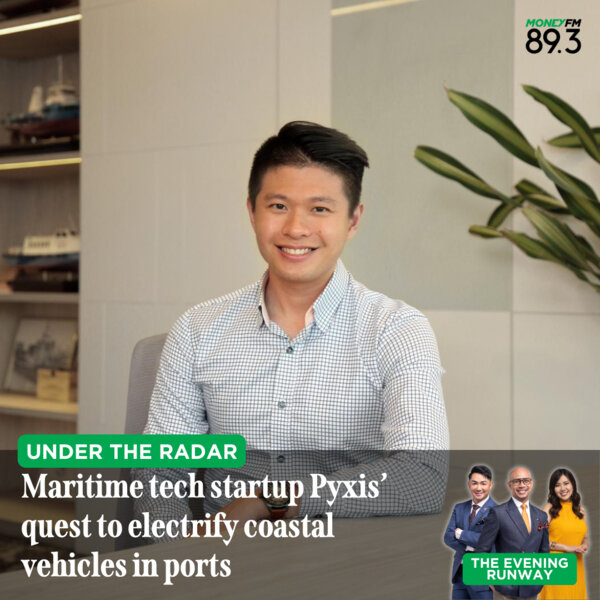
Helping tugboats, ferries, pilot boats and other coastal vehicles electrify and ride the green wave – that’s what we are going to talk about today.
Founded in 2022, our guest for today Pyxis is a maritime electrification technology startup that aims to create a more sustainable future at sea by easing mass commercialisation and adoption of electric coastal vehicles.
Supported by leading coastal vessel owners and government agencies, Pyxis accelerates maritime decarbonisation while elevating vessel performance and management.
For one thing, the firm is focusing on retrofitting existing vessels with full electric propulsion systems including 70 coastal vessels owned by maritime services firm Eng Hup Shipping.
With the Maritime and Port Authority of Singapore mandating all new harbour craft in Singapore waters to operate on low-carbon energy solutions and reduce emissions by 15 per cent from 2021 levels, what opportunities does this present for Pyxis in the longer run?
Meanwhile, the firm had in February 2024 raised S$4.5 million in a seed funding round led by Motion Ventures and Shift4Good. The round featured participants such as Enterprise SG’s Seeds Capital, MarImpact, Tian San Shipping and LCC Resources.
But what is the strategic value behind this group of investors and how does the maritime startup intend to use the money?
On Under the Radar, The Evening Runway’s finance presenter Chua Tian Tian posed these questions to Tommy Phun, Founder, Pyxis.
|
|
|
|
|
16:26
|
MAR 4, 2024
04/03/24 - Under the Radar: From serving the Italian military to civilians – Panerai on its positioning over the years and what that means to its product pipeline and expansion plans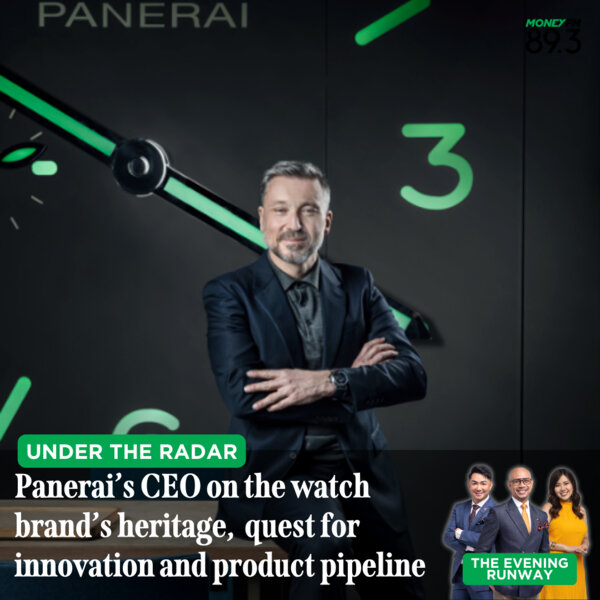
Radium is an element we see in our periodic tables during chemistry lessons. But did you know that it was once used to make watches for naval divers thanks to its self-luminescence quality?
In fact, one luxury firm used to supply such timepieces to the Italian military back in the early 1900s.
And while Radium was banned in the 1960s due to its radioactive properties, the glow-in-the-dark feature of this company’s watches remains its key selling point up till today.
We’re talking about the Italian watch brand Panerai. Founded in Florence in 1860 as a workshop, shop and subsequently school of watchmaking, Panerai had for many decades supplied the Italian Navy and its specialist diving corp in particular with precision instruments.
At that time, the designs developed by Panerai were covered by the Military Secrets Acts. It stayed that way for many years and the models were only launched on the international market after it was acquired by the Richemont Group in 1997.
Fast forward to today, Panerai is known for its rugged and bold timepieces, with action stars such as Arnold Schwarzenegger, The Rock Dwayne Johnson and others among wearing them. But the firm is also seeing growing interest among the female community.
So how does Panerai assess its positioning and customer base over the years and what does it mean for the firm when it comes to future designs and product pipeline?
Meanwhile, Panerai had in June 2023 launched its global flagship boutique in New York, but which are the key markets for the firm? What are the opportunities ahead and where does Panerai intend to expand into next?
On Under the Radar, The Evening Runway’s finance presenter Chua Tian Tian posed these questions to Jean-Marc Pontroue, CEO, Panerai.
|
|
|
|
|
25:49
|
FEB 28, 2024
28/02/24 - Under the Radar: How far has the increased adoption of generative AI solutions translated into greater hardware services demand at Procurri?
Cloud computing, big data and artificial intelligence – these functions require sophisticated hardware and regular maintenance in order to work seamlessly.
But have you wondered who are the ones managing the lifecycle of the hardware products, from regular maintenance to disposition? That’s exactly what we are going to talk about today.
Listed on the Singapore Exchange since 2016, Procurri Corporation works with its channel partners to provide more sustainable, more intelligent and more competitive IT solutions.
The firm focuses on three core pillars: (a) supplying hardware products (b) providing third party maintenance solutions for all major OEMs, supporting (b) Asset Disposition and disposal solutions for IT hardware.
Proccuri said it currently has processing plants in the UK, Germany, North America, Singapore, Malaysia and India.
The firm had also last year revealed plans to grow its business in the Asian market. But to what extent has that got to do with the ongoing boom in generative AI solutions?
Also – have the optimism and growing adoption of generative AI filtered down to Procurri when it comes to demand for hardware services?
On Under the Radar, The Evening Runway’s finance presenter Chua Tian Tian posed these questions to Mat Jordan, Executive Director and Chief Executive Officer, Procurri.
|
|
|
|
|
27:58
|
FEB 27, 2024
27/02/24 - Under the Radar: What does MICE operator Experia’s growth story look like after the Singapore Airshow 2024?
Nearly 60,000 people – that’s the number of trade visitors who attended the first four days of the Singapore Airshow 2024.
The number of attendees also dwarfs the previous record set six years ago, by about 10 per cent. That was when the last full scale show was held, before the biennial event was scaled down in 2020 and 2022 due to the COVID-19 pandemic.
While the exact number of deals made and the value of them were not disclosed, multiple deals were made at the event.
China’s Comac sealed an order of 50 planes from Tibet Airlines. While APAC carriers such as Thai Airways, Vietjet and Taiwan’s Starlux bought 77 planes from major aircraft manufacturers Airbus and Boeing.
So what does this suggest about the recovery of Singapore’s MICE industry post-pandemic, and how are MICE operators positioning themselves for future growth as economic activities come back to life?
Well, we’re going to pose the questions to the organiser of Singapore Airshow 2024, Experia Events.
Incorporated in 2005, Experia specialises in conceptualising and curating trade events of strategic interest that spur industry developments, and also manages the Changi Exhibition Centre.
On Under the Radar, The Evening Runway’s finance presenter Chua Tian Tian posed these questions to Leck Chet Lam, Managing Director, Experia.
|
|
|
|
|
20:12
|
FEB 26, 2024
26/02/24 - Under the Radar: Making cables for MRT lines, Jewel Changi Airport and Gardens by the Bay – Tai Sin Electric on building a new product line amid the pandemic and future regionalisation plans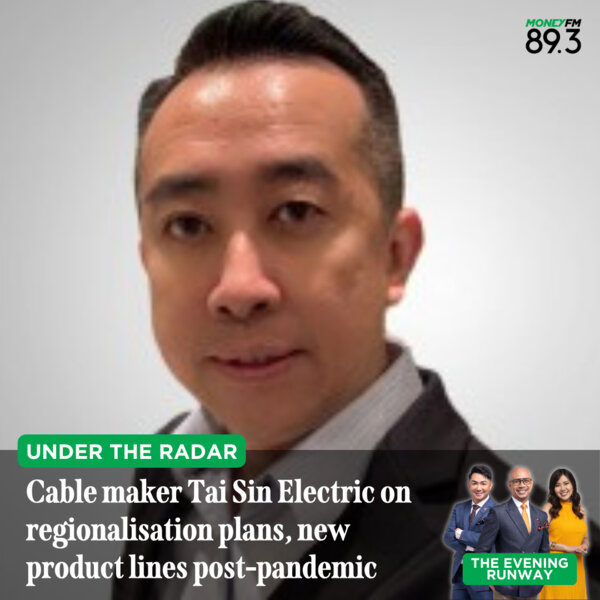
Making cables for MRT lines, Jewel Changi Airport and Gardens by the Bay – that’s what we’re going to talk about today.
Founded in 1980, our guest Tai Sin Electric makes cables and wires for a diverse range of industries for both the private and public sectors and in all categories of industrial, commercial, residential and offshore and marine projects.
They include items like low voltage cables, medium voltage cables, instrumentation cables as well as fire resistant cables and wires.
The firm has since completed over 1,000 projects including at the Changi Airport Terminal 4, the National University of Singapore, the SingPost Logistics Hub, the Singtel Data Centre, the National Gallery Singapore, the Jurong Reclamation plant, Rolls Royce Seletar Campus and at Jem Shopping Mall.
But what is interesting about Tai Sin Electric is its move to expand beyond cables and wires amid the pandemic.
In 2019, the firm was setting its sights on exporting its products to other Southeast Asia countries by taking part in the second run of Enterprise Singapore’s Scale-up SG, before activities came to a grinding halt as a result of lockdowns seen in many countries.
Instead, the firm made the decision to build a new product vertical looking at electrical power distribution with busbar trunking systems. This was a bold move as the systems were a direct competitor to the cables and wires that were Tai Sin’s bread and butter.
But why did the firm decide to push ahead with the move and how far has this brought about tangible benefits for the firm? Also, with economies revving back to life post-pandemic, how far is Tai Sin Electric picking up on its expansion plans?
On Under the Radar, The Evening Runway’s finance presenter Chua Tian Tian posed these questions to Willy Chua, Head of Marketing & Group Corporate Development, Tai Sin Electric Limited.
|
|
|
|
|
25:18
|


